Got Fool Once Again but It Stops Now

Nothing says opportunistic like selling h2o for pain command.
The first principle is that you must not fool yourself — and you are the easiest person to fool.
–Richard Feynman
I like to think of myself as a rational person, but I've been fooled by my ain experience once more and over again. I've made bad decisions and wasted time and money believing what I was seeing, instead of being objective and looking at the bear witness. Ane of my virtually memorable lessons has come over the past 14 years with my Labrador Retriever, Casey.
First the personal
Nosotros caused Casey as a puppy, and she was less than a year onetime when she started limping. Investigations confirmed dysplasia, a genetic status that leads to degenerative joints, arthritis, and pain. We were devastated. After considering the few treatment options that existed, we decided to skip surgery and treat it conservatively. I had no want to start her on a lifetime of anti-inflammatory drugs, being very familiar with their side effect contour. I was familiar with a supplement used widely in humans that had some weak but somewhat promising testify: Nosotros started giving her glucosamine and chondroitin supplements regularly. And nosotros watched and waited.
It took some time, but Casey did appear to ameliorate. We were thrilled. Life went on, and other than the occasional rough play session, Casey's limping was mild, and she thrived. We connected the supplements, confident that we were doing proficient. But eventually I started paying attention to the emerging evidence on glucosamine and chondroitin. Once touted as a panacea for arthritis and joint pain, there had finally been some high-quality trials conducted – and the results were disappointing. Even this blog covered the issue, and contributors like Harriet were skeptical of glucosamine. Its supposed mechanism of action really wasn't even that plausible. I started to wonder if the supplements were really doing annihilation for my dog's pain. Eventually I decided on a trial – and so I stopped the supplements most seven years after I started them. Neither my married woman nor I could detect any difference at all in her mobility. Nor did the veterinary. We'd been fooling ourselves, spending hundreds of dollars in the procedure.
Now I'm back in a situation with Casey where I'm making treatment decisions based on wishes and expectations, and not fact. The limping seemed to be managed with regular walks, and keeping her weight nether control (some medication for a thyroid condition helped). Just in the past few years, there have been changes. The rare utilise of meloxicam (an anti-inflammatory) gradually became a regular daily dose. The tail kept wagging, and we still had our long walks, just the energy started to refuse. A trip to the veterinarian emergency room a year agone led to a prescription for gabapentin (a drug typically used for neuropathic pain) which I've been reluctant to discontinue, despite the lack of good evidence it works, and even as her mobility has connected to deteriorate. At present she's closing in on 15 years old. Casey's legs are giving out on her, and she's falling more and more. Just this week, she'due south decided she doesn't want to go for walks anymore, and she'due south not finishing her meals – which never, ever occurs with Labradors unless something is seriously wrong. She'south becoming a shadow of the dog we've known. I think we've nearing a decision bespeak – we're about at the limits of what a domestic dog'southward torso can practise, and what veterinary medicine can offering. And while I know that all of this is to exist expected in a Labrador Retriever who is 14 years old, I still want something, anything, that will requite united states more fourth dimension.
And now the the professional
"The three most unsafe words in medicine: in my experience."
-Mark Crislip
It's exceptionally difficult to accept that you're fooling yourself. Equally a pharmacist, I accept spent a large part of my career speaking with people about health, illness, and cocky-care decisions. Some of most interesting discussions have been about homeopathy, because I know that any effects that patients may report are unrelated to the production itself – because homeopathy is finer the same as doing nothing. Homeopathy is the air guitar of medicine – it'due south packaged like a drug, and sold in pharmacies alongside actual medications, simply the product are duplicate saccharide pills, with no medicine in them at all. Rigorous trials demonstrate what common sense would suggest: Homeopathy is no more constructive than an equivalent placebo. Information technology's not difficult to imagine the potential harm from someone using a production like a homeopathic spray for asthma. But beyond the avoidance of life-saving treatments, there'southward the wasted resources and the overall illusion that fake medicine, like homeopathy, can create. A pharmacy I once worked in on a part-time basis had a sizeable homeopathy business organisation back when homeopathy was more than of a fringe product. I would never recommend the remedies, but was regularly asked for them. And I learned pretty speedily that information technology was difficult to convince regular users that they the beneficial furnishings they reported weren't due to the remedies. Many were fiercely loyal to their particular product, for their particular ailment. They trusted their culling medicine provider, usually a naturopath or homeopath. Suggestions that they might try reassessing them were rejected and sometimes even taken as insulting – subsequently all, who was I to tell them (even gently) that the product had no medicine in it at all? From what they could see, homeopathy working for them, and that was all the evidence they needed.
Equally 50 started reading the Science-Based Medicine blog and began looking more critically at the evidence base, I changed my communication. With patients seeking arthritis and pain relief, I stopped sharing anecdotal evidence ("I give information technology to my dog!") and focused on what the evidence was saying. I wasn't all that successful in my dialogue with patients – or health professionals for that matter, who sometimes seem so reluctant to allow go of what they already know to be true. If it's non the belief that "the patient knows best", it'due south the accumulation of positive anecdotes that can turn health professionals into believers, even when the bear witness says otherwise. I've spoken with pharmacists who run across no contradiction discussing the molecular basis of drug interactions while simultaneously believe that h2o has some sort of magical retentiveness. "I've seen information technology work" they shrug, "science doesn't know everything."
The reasons why nosotros believe these anecdotes, despite the scientific discipline, take been detailed at length in other posts. Add in the conflict of interest that that comes from making a profit, and it's possibly not surprising that many pharmacies sell products that lack good evidence of efficacy. And this is where I accept upshot with many of my peers who work in customs (retail) pharmacy settings – I debate that selling implausible and ineffective treatments to consumers, given a pharmacist's professional person responsibility, is unethical. I object to the auction of dubious products in pharmacies because I believe that pharmacies are places of health care delivery, with a responsibility to the public that goes beyond bones commercial business ideals. (And as I've pointed out, pseudoscience fails that bar, too.) In an environment like a pharmacy, consumers may be more accepting. They may be in a vulnerable state. And in one case that belief in in identify, it may be hard to shake it. Confirmation bias can be powerful, and it tin can lead health professionals and consumers alike into beliefs near health that are not substantiated when you take an objective look at all the data.
Who better to exploit the public's trust in pharmacists than maybe the pharmacy profession itself? In Australia, there'southward a new trend to utilize naturopaths in pharmacies to promote guide the selection of supplements and alternative medicine. With pharmacies held in loftier regard by the public, this move is expected to requite more legitimacy to the alternative medicine system of naturopathy. And while naturopaths themselves may be well significant, it's been pointed out repeatedly at this blog that naturopaths have an extreme and very selective view of the scientific evidence. Naturopaths can give good advice, just this is when that advice happens to be congruent with the naturopathic philosophy. But naturopaths will routinely pass up scientific bear witness that doesn't adapt to their beliefs about medicine. If you ignore the not-confirmatory evidence about supplements and pick and choose what you lot want to accept as fact, then yous'll exist more probable to believe that supplements offer practiced health benefits. Few do. This move has brought criticism from within and outside the chemist's shop profession as a thinly-veiled try to heave sales:
The president of the Australian Medical Association Dr Brian Owler said pharmacists needed to re-evaluate their professional roles. "These things run the risk of diminishing the professional reputation of pharmacists and suggests they are more of a shop rather than a place to seek advice nearly medications," he said.
Greg Turnbull, spokesman for the Pharmacy Guild of Australia, said if members employed complementary therapists, they should "be mindful of their duty of intendance and responsibleness for whatever advice or service provided within their pharmacy"
Australian chemist Ian Carr is particularly disquisitional:
"The problem is pharmacists demand complete oversight of what goes on in the chemist's shop," he said. "You are in accuse of preparation your staff appropriately, so that you know, correct downwards the line the correct communication is being administered. "With a naturopath operating within your pharmacy they would need 100% supervision – simply this is not the case." Mr Carr said the uptake of naturopaths in pharmacies has been increasing due to public interest and also the manufacture non being supervised.
Carr is such a potent advocate for evidence in medicine that his chemist's shop not only has no naturopaths, but he's taken steps to aid consumers brand more informed choices. Like the Us and Canada, the Australian medicines regulator has 2 standards for wellness products – one which requires evidence, and i for products that lack prove of efficacy. For the latter products, in Carr's chemist's they are sold with this sticker:
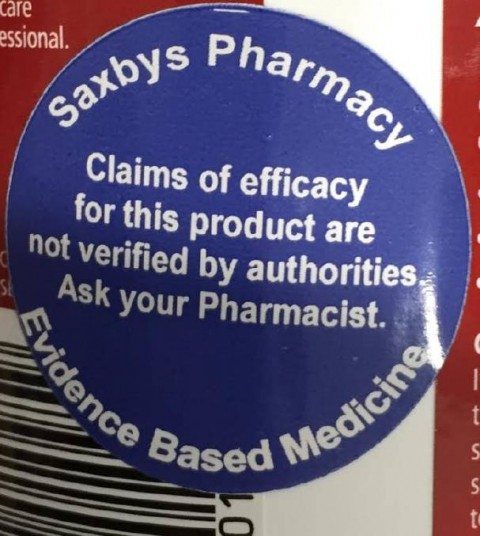
Stickers placed on products that haven't been evaluated for efficacy by regulators.
It'southward not just the traditional alternative medicine – even some more than conventional only very old products sold in pharmacies lack good show of efficacy, and are probably of questionable efficacy. Used fairly and consistently, this blazon of labeling supports consumer self-selection, but also emphasizes which products are backed by good bear witness of efficacy. It's besides an opportunity for consumers to initiate a dialogue with pharmacists about the show, hopefully supporting good discussions about handling options. In the long run, information technology may assist consumers make health care decisions that are more informed past the scientific evidence.
Conclusion: The personal must give manner to the empirical
Our personal experiences and anecdotes may be meaningful to us, but when it comes to health and medicine, they are a poor style to decide therapies and treatments that piece of work. Recognizing that I was fooling myself with glucosamine and chondroitin was difficult to have, but information technology was an of import lesson that has stuck with me and (I hope) kept me apprehensive about the relevance of my own experiences and observations as a health professional. It's likewise made me more sensitive to the perspectives of others in my dialogue with patients about their own perceptions of health. Nosotros believe what we see. We want to believe what we are doing is helping. And when we're desperate, nosotros want to exercise something…anything…rather than facing facts. And today, as I'g carrying my dog up and down flights of stairs, and watching her struggle to stand upwardly, I'm struggling with that very issue.
Source: https://sciencebasedmedicine.org/fooling-myself/
0 Response to "Got Fool Once Again but It Stops Now"
Post a Comment